UIA 2008 infopoint competition

Tuesday, June 17, 2008 § 1


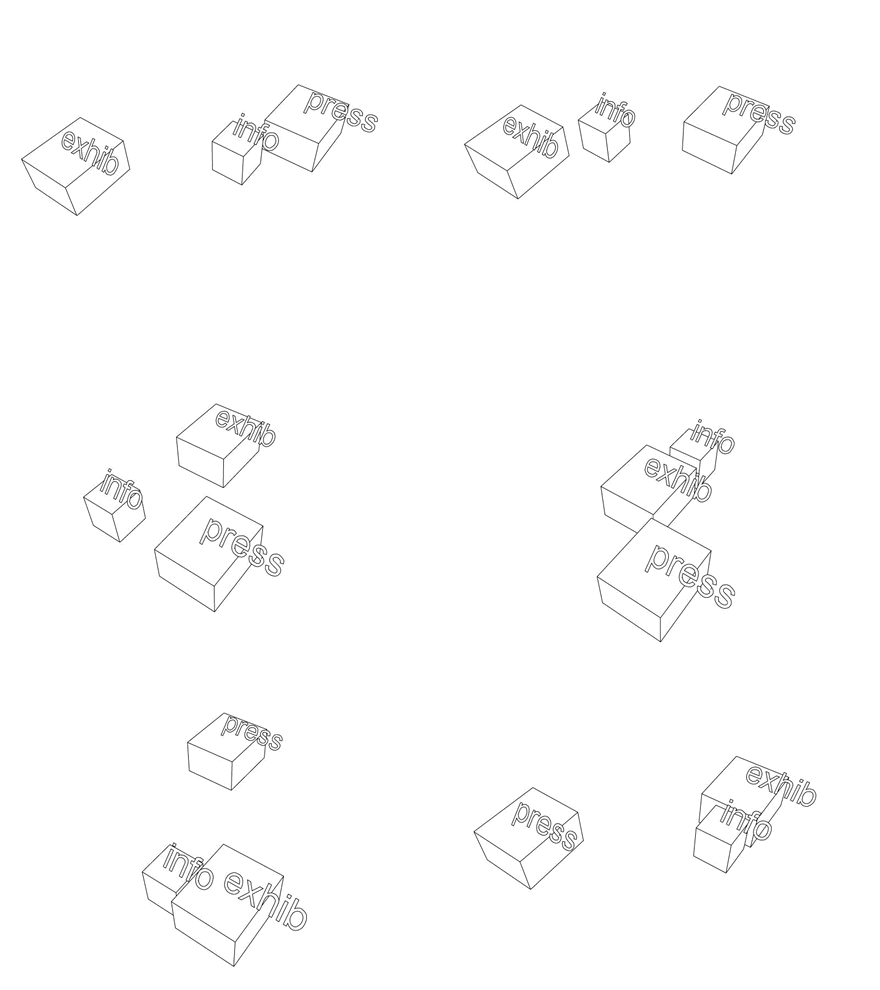
This is the entry for the UIA 2008 competition. Two stochastic algorithms are used for the generation of the project. The first one is generating random boxes with the aim to create the spaces that will host the program (info point, exhibition area, press area). Certain criteria are set (distance between the volumes, shape of the public area etc.) which have to be met in order for the algorithm to position the space. The second algorithm is finding the bounding box of the 3 spaces and is then stochastically generating vertical cutting planes that define a structural system that creates a canopy above the 3 volumes. A rather weak linear element - that of a plane cutting a box - is repeated and weaved in such a way that the result becomes rigid and structural.


The light strategy followed is shifting the focus of what is being perceived as the dominant element during the day and during the night, from the structural canopy (day) to the glowing rectangular volumes (night).


(in collaboration with katerina tryfonidou, fotis vassilakis, dora christoforidou)

L-SYS_HRRU

Sunday, May 18, 2008 § 1


Some experiments with L-systems and how they can be used as form generating processes. Here is an example for a highrise structure. The l-system in this case is used more as a procedural modeling tool, than a truly generative system, but still recursion plays an important role for the development of the form.


Conferences_log

Tuesday, April 15, 2008 § 1

While the future is uncertain (…) here are some events that I will certainly be participating this spring/summer:

Critical Digital Conference: What Matter(s)?
This coming weekend I will be in Boston for the Critical Digital Conference at the gsd. I will be presenting together with Katerina Tryfonidou. The title of the presentation is “What comes first: the chicken or the egg? Pattern Formation Models in Biology, Music and Design”. More information here.

EAAE/ARCC 2008 Research Conference.
25 - 28 June 2008 in Copenhagen. I will be presenting with Katerina Tryfonidou and Magdalena Pantazi. The title of the presentation: “Pattern Formation Models”.
More information here.

XXIII UIA World Congress of Architecture. Torino 2008.
June 29 – July 3 in Torino. Presenting with Katerina Tryfonidou and Magdalena Pantazi: “Digital Cartographies: mapping the global and local networks”. More information here.

v.2

Tuesday, April 1, 2008 § 0


Pattern Formation Models

Tuesday, February 19, 2008 § 1

Here is a link to the blog of the class that I am teaching this semester at Washington University. The class is looking at several different pattern formation models, deriving mainly from biology or mathematics, and how they can organized through the concepts of pre-formation and self-organization.


What if NYC... competition. Honorable mention.

Monday, February 11, 2008 § 0


This the entry for the "What if new york city..." competition, that got a honorable mention. The idea is a development of the "inflateit" project. Here the focus is on the implementation of the project while inflateit was more about the development of a protocol. Also the inflatable units are following a different pattern in this version. More information for the project here. The competition website with all the entries here.

InflateIt

§ 0

InflateIt is an idea for the development of a protocol for the production of modular housing units. The units are developed in a hexagonal pattern, while the walls are inflatable. The elevation pattern is defined through a light study. The production of more units results in the expansion of the database with the lighting solutions. More information here.


Shifting Lines final review and exhibition (12/10/07)

Friday, February 8, 2008 § 0

Photographs from the review and the exhibition for the Shifting lines to surfaces/Virtual to empirical class. The exhibition was up at Givens Hall from 12/09/07 to 01/05/08.
Guest reviewers were Heather Woofter, Dr. Mitchell Joachim and Sung Ho Kim.


interactive wall

Thursday, January 10, 2008 § 1


A study for an interactive wall, developed together with Fotis Vasilakis. The idea was that a tiled surface will react to the presence of people close to it, which will cause the tiles to rotate around their vertical axis, locally. Obviously an idea like this has to be based on sensors in order to operate, however is still in a very primitive stage.
This study was implemented using expressions and wire parameters in 3dstudio max.


axi:ome.net

Friday, November 30, 2007 § 0

Axi:Ome's website is up and running! It took us some time to finish, but it is finally done...